
If (like me) your brain always runs straight to doom and gloom and always ends up thinking of Worst Case Scenario, you’re not alone.
If someone didn’t reply to my message, I assumed I had said something wrong. If a small plan changed unexpectedly, my mind quickly jumped to imagining everything falling apart. Even the smallest uncertainty could spiral into a full-blown disaster in my head.
And the ironic part?
Most of the things I worried about never actually happened.
Yet the stress they created felt very real. The anxiety, the racing thoughts, the endless “what ifs”—they all drained my energy long before anything in reality had even occurred.
Over time, I realized something important: worst-case thinking is not reality. It’s simply a pattern of thinking that our mind learns.
The good news is that patterns can be changed.
With a few small mindset shifts, we can slowly retrain our minds to move away from constant fear and toward calmer, more balanced thinking. These are some of the shifts that helped me the most when I noticed myself slipping into worst-case scenario thinking.
Why Do We Always Imagine the Worst-Case Scenario?
Our minds are wired to protect us.
Long before modern life existed, humans survived by constantly scanning their environment for danger. The brain learned to anticipate threats because that increased the chances of survival.
Even though most of us are no longer facing life-threatening dangers on a daily basis, our brains still operate with that same protective instinct. When something uncertain happens, the mind quickly tries to prepare for possible problems.
Unfortunately, this protective instinct often goes too far.
Instead of simply preparing us, it pushes us into worst-case scenario thinking, where the mind begins to imagine negative outcomes without any real evidence.
It feels like we’re being cautious or prepared, but in reality we’re just exhausting ourselves with unnecessary fear.
Signs You Are Stuck in Worst-Case Scenario Thinking
Sometimes we don’t even realize we’re doing this. Worst-case thinking can quietly become a habit.
You might notice this pattern in yourself if:
- You assume the worst outcome before knowing the full situation
- A small problem quickly becomes a huge mental catastrophe
- You replay conversations in your head and imagine negative interpretations
- You constantly worry about things that haven’t happened yet
- Your mind jumps to conclusions before you have any real facts
If any of these sound familiar, don’t be too hard on yourself. Many thoughtful and sensitive people experience this pattern.
The key is not to eliminate thoughts entirely, but to learn how to guide them in a healthier direction.
How to Stop Overthinking the Worst-Case Scenario?

Breaking the habit of worst-case thinking doesn’t happen overnight. But with awareness and practice, we can slowly retrain our minds to respond differently.
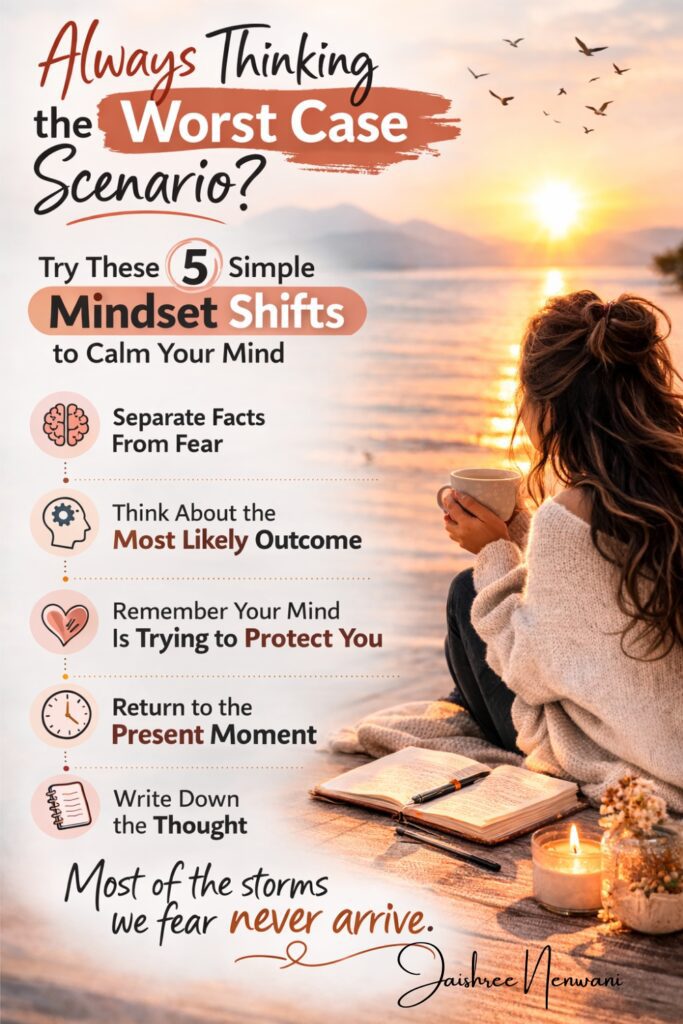
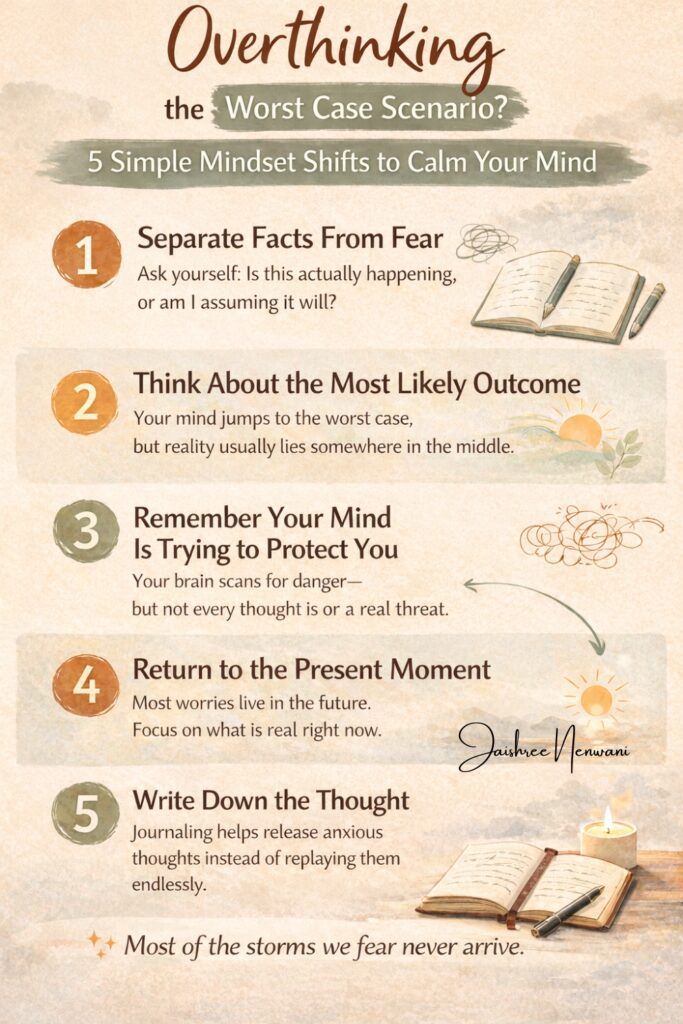
Here are five mindset shifts that have helped me stop overthinking negative outcomes.
1. Ask Yourself: “Is This a Fact or Just a Fear?”
One simple question has saved me from countless spirals of overthinking.
Whenever my mind begins imagining a negative scenario, I pause and ask:
Is this actually happening right now, or am I just assuming it will happen?
Most of the time, I realize that the thought is based purely on fear rather than evidence.
Learning to separate facts from assumptions helps slow down the emotional reaction and brings the mind back to a calmer place.
2. Focus on the Most Likely Outcome
When we are caught in overthinking, our mind tends to jump directly to the worst possibility.
But reality usually lies somewhere in the middle.
Whenever I feel myself slipping into catastrophic thinking, I remind myself to consider three possibilities:
- The worst-case scenario
- The best-case scenario
- The most likely scenario
Almost every time, the most likely outcome is far less dramatic than what my mind initially imagined.
This simple shift helps bring my thoughts back to reality instead of letting fear control the narrative.
3. Remember That Your Mind Is Trying to Protect You
For a long time, I used to get frustrated with myself for overthinking.
I would wonder why my mind couldn’t simply relax.
But eventually I realized that my brain wasn’t trying to sabotage me—it was trying to protect me.
Our minds are naturally wired to anticipate danger. When uncertainty appears, the brain tries to prepare us for possible problems.
Understanding this made me more compassionate toward my own thinking patterns.
Instead of fighting my thoughts, I now gently remind myself that not every imagined danger is real.
4. Bring Your Focus Back to the Present Moment
Worst-case thinking almost always lives in the future.
It thrives on endless “what if” questions.
What if something goes wrong?
What if things don’t work out?
What if everything falls apart?
But none of these things are actually happening in the present moment.
Whenever I catch my mind wandering too far into imagined futures, I bring my attention back to the present. I take a deep breath, notice my surroundings, and remind myself that right now, everything is okay.
This simple grounding practice often dissolves a surprising amount of anxiety.
5. Write the Thought Down Instead of Carrying It in Your Head
Overthinking grows stronger when thoughts stay trapped in our minds.
The brain keeps replaying the same story again and again, each time adding a little more fear.
This is where journaling has been incredibly helpful for me.
Here’s how you can start journaling.
Whenever I feel stuck in a loop of worst-case thinking, I take a notebook and write down exactly what I’m afraid of.
Then I ask myself a few questions:
- What exactly am I worried will happen?
- How likely is this scenario?
- If the worst did happen, how would I handle it?
Once the thought is written down, it often loses its intensity. What once felt overwhelming becomes something I can look at calmly and objectively.
Sometimes the mind simply needs a place to release the worry instead of carrying it endlessly.
Train Your Mind to Expect Better Outcomes
Our minds are powerful storytellers.
If we allow them, they can easily create endless scenarios filled with fear and doubt. But the encouraging truth is that the brain is also capable of learning new patterns.
With awareness and practice, we can slowly teach our minds to expect more balanced—and sometimes even positive—outcomes.
In my own life, I’ve realized that most of the disasters my mind prepared for never actually arrived.
And the few challenges that did appear? I was far stronger and more capable of handling them than I had imagined.
So the next time your mind begins writing a worst-case story, pause for a moment.
Take a breath.
Remind yourself that thoughts are not always reality.
And gently guide your mind back toward calm, trust, and possibility—because very often, life turns out far kinder than the fears we create in our heads.
Wrapping Up: Learning to Quiet the Worst-Case Voice
Overthinking the worst-case scenario can feel exhausting. When the mind keeps imagining problems that haven’t even happened yet, it quietly steals our peace in the present moment.
I’ve learned that the goal isn’t to completely stop thoughts from appearing—that’s nearly impossible. The real shift happens when we stop believing every fearful story our mind creates.
Sometimes the mind will still whisper a worst-case possibility. But now, instead of immediately accepting it as truth, I pause, question it, and gently guide my thoughts back to a more balanced place.
With practice, these small mindset shifts begin to change the way we respond to uncertainty. We stop reacting with panic and start responding with awareness.
And over time, something surprising happens: the mind becomes calmer, the worries lose their intensity, and life feels a little lighter.
Because the truth is, most of the problems we imagine never actually arrive.
So the next time your mind begins to paint a worst-case picture, take a breath and remind yourself:
Not every thought your mind creates is the truth.
Sometimes peace begins with that simple realization.