
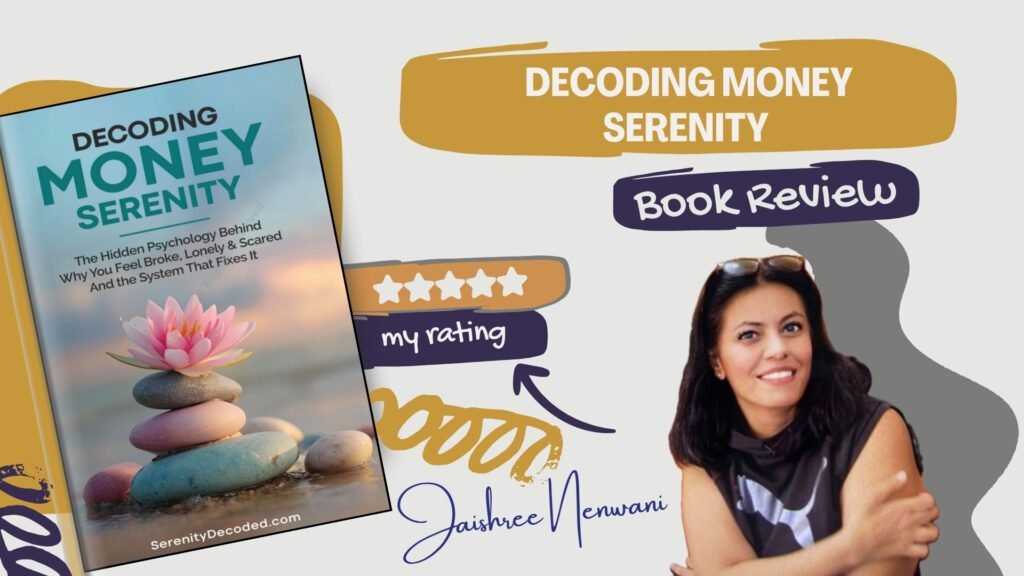
Money has a funny way of following us everywhere. We can be having an otherwise perfectly normal day and suddenly remember a bill, an unexpected expense, an old financial mistake, or something sitting on our credit card—and there goes the peace. I have experienced that mental noise myself, which is probably why Decoding Money Serenity caught my attention. Instead of simply telling me how to manage money better, the book asks a more interesting question: Why do we behave the way we do around money in the first place?
Written around the idea that financial stress is not just about numbers, Decoding Money Serenity explores the hidden psychology behind feeling broke, anxious, guilty, overwhelmed, or simply uneasy about money. Its introduction immediately establishes that the book isn’t interested in blaming the reader. It wants us to understand our behaviour before trying to change it.
Understanding the Psychology of Money Stress
What I liked most about the book is this shift in perspective.
The book compares this to a “stress leak”: small unresolved concerns that gradually affect other areas of life. Money stress can spill into relationships, decision-making, self-perception, and even our ability to concentrate.
Financial stress isn’t always caused by one enormous financial disaster. Sometimes it is the accumulation of dozens of smaller worries—checking balances repeatedly, postponing decisions, worrying about future expenses, or constantly wondering whether we are doing enough.
That felt very real to me. Sometimes the number in the bank account isn’t the only problem. It’s what that number makes you feel.
Why Financial Guilt Doesn’t Actually Help?
Another section I found particularly interesting is the discussion around financial guilt.
We often assume that feeling guilty about our financial mistakes will motivate us to do better. But the book argues that constant guilt can actually keep us stuck. When every financial mistake becomes evidence that we are irresponsible or “bad with money,” we become more likely to avoid looking at the problem altogether.
I appreciated that the author doesn’t remove responsibility from the equation. Instead, the message is essentially: take responsibility without punishing yourself.
That distinction makes a lot of sense. The book encourages readers to look at past decisions with curiosity rather than endless self-criticism and to ask what they were actually trying to solve at the time.
Scarcity, Financial Habits and Emotional Spending
The book gets even more interesting when it explores scarcity.
Scarcity isn’t presented simply as “not having enough money.” It can also mean not having enough time, energy, security, or mental space. When we feel constantly stretched, our thinking can become narrower, and we naturally start looking for immediate relief rather than long-term solutions.
I also enjoyed the chapter on emotional spending because it avoids the usual judgmental approach. Rather than calling emotional spending foolishness or carelessness, the book presents it as a form of communication—an attempt to meet an emotional need such as relief, identity, belonging, or control.
That doesn’t mean every purchase is justified. It simply gives us a better question to ask: What was I actually looking for when I bought this?
A Practical Approach to Financial Peace

Another strength of Decoding Money Serenity is that it doesn’t stop at explaining the problem. Throughout the book, readers are given “Personal Action Steps” involving reflection, expectations, decisions, feelings, and control. The exercises encourage readers to notice their patterns rather than trying to overhaul their entire financial life overnight.
I particularly liked the idea that different people may need different strategies. The book identifies four financial styles under stress—the Avoider, Controller, Hopeful, and Firefighter—and explains both the strengths and limitations of each.
That makes the book feel more personal than the usual “save more, spend less, invest early” advice. Those suggestions may be sensible, but they don’t always account for the person receiving them.
I found Decoding Money Serenity thoughtful, compassionate, and refreshingly different from conventional personal-finance books. It doesn’t promise a magical shortcut to wealth. Instead, it asks us to understand the relationship between our financial circumstances, emotions, habits, and decisions. For anyone who feels that money problems are affecting their peace of mind—not just their bank balance—I think this book offers some worthwhile reflection. You can buy this book on Amazon – Decoding Money Serenity or Decoding Money Serenity official website.



4 responses to “Decoding Money Serenity: A Different Way to Look at Money”
This is a must-read. I need as much help as I can get with managing my finances and setting clear financial goals.
I think this is a must-read, especially right now. Money is getting tighter, and so are our emotions!
I’m glad you mentioned emotional spending because I honestly think that’s something I’ve struggled with for a long time. I’m really curious to see what the book has to say and hopefully learn a few things that can help me be more mindful with my spending. Thanks for sharing your review!
I do think that emotional spending is such a big issue – so is comfort spending. This is such a great look.