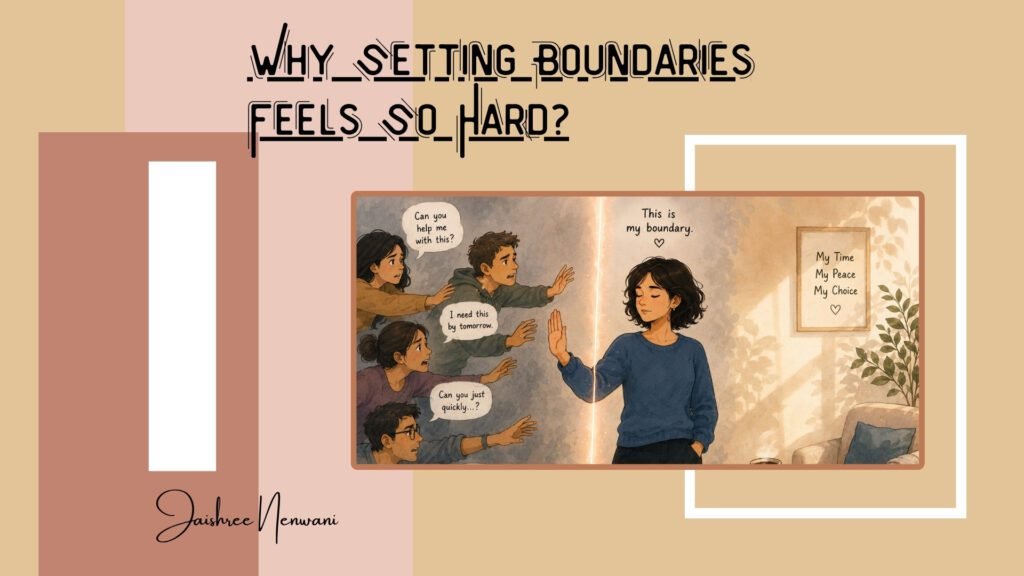
You know you need boundaries.
You know you should say no sometimes. You also know you can’t keep being available to everyone. You understand that constantly putting other people’s needs before your own is exhausting.
And yet, when the moment comes to actually set a boundary, something happens.
Your stomach tightens. And You start overthinking.
“What if they get upset?”
“Am I being selfish?”
“Maybe I should just adjust this one time.”
And before you know it, you’ve said yes again.
So Why Setting Boundaries Feels So Hard??
Because boundaries aren’t just about telling other people what you will or won’t accept. They often challenge deeply rooted fears about rejection, conflict, guilt, disappointing people, and being seen as selfish. If you’ve spent years keeping everyone comfortable, choosing yourself can feel uncomfortable—even when it’s healthy.
And that’s the part nobody tells you.
Sometimes, the hardest part of setting a boundary isn’t saying the words.
It’s dealing with everything you feel after saying them.
What Are Healthy Boundaries, Really?
A boundary is simply a limit you set around your time, energy, emotions, availability, or personal space.
It tells people what you are comfortable with and what you are not. But a boundary isn’t a demand to control someone else’s behaviour.
For example:
“You’re not allowed to call me after 10 p.m.” is an attempt to control someone.
“I don’t take calls after 10 p.m. I’ll respond tomorrow” is a boundary.
See the difference?
A healthy boundary focuses on what you will do, rather than trying to control what someone else does.
And that can feel surprisingly empowering.
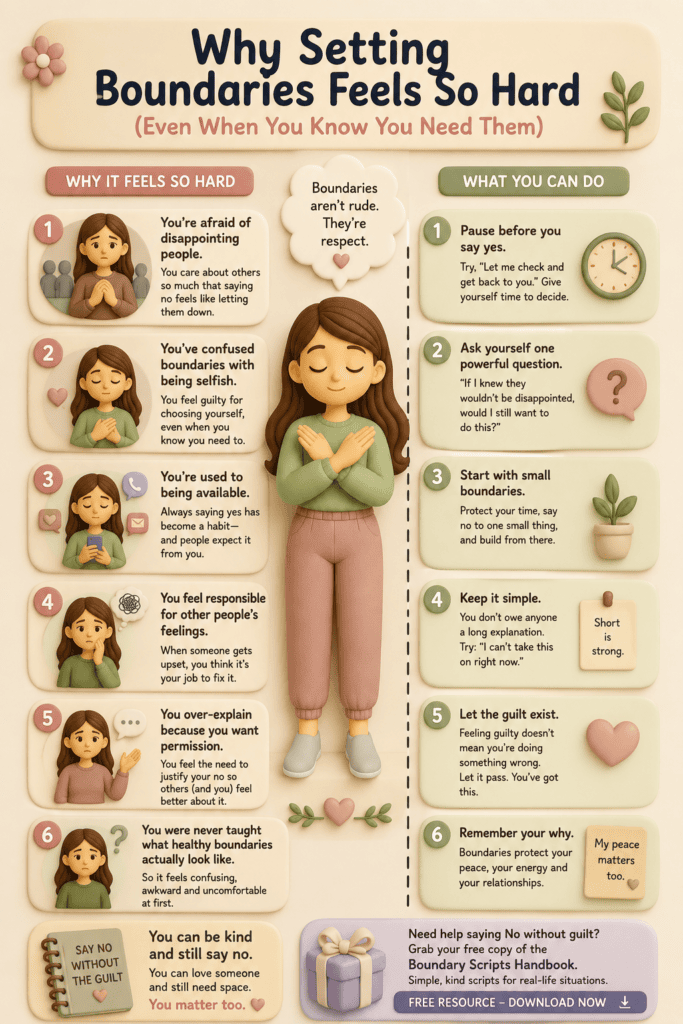
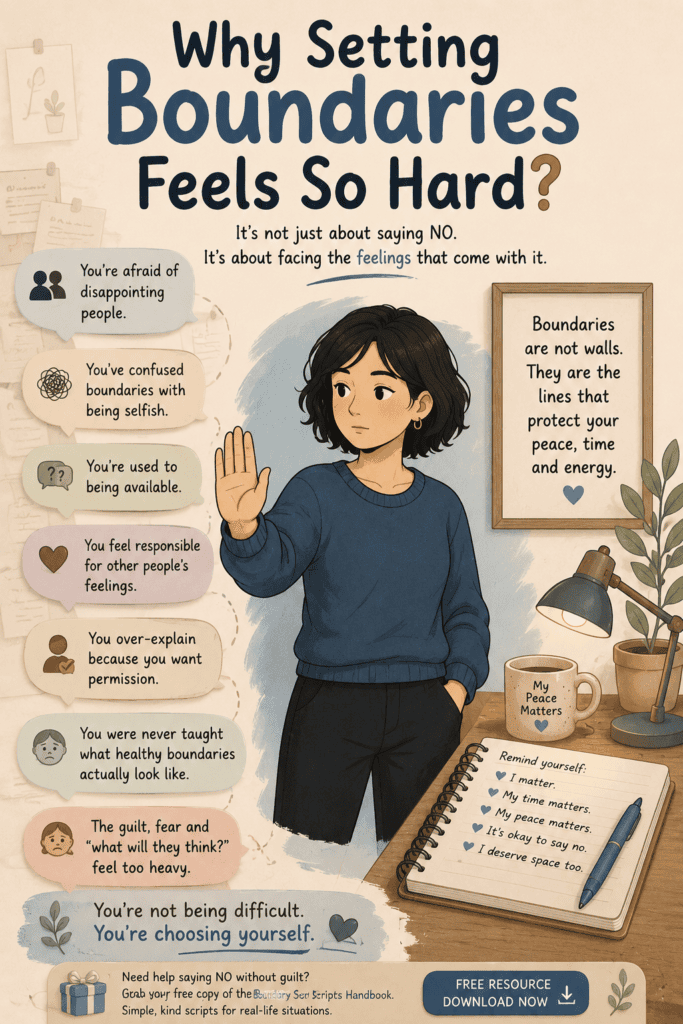
1. You’re Afraid of Disappointing People
This is probably one of the biggest reasons setting boundaries feels so difficult.
You care about people.
You don’t want to hurt anyone.
You don’t want someone thinking you’re rude, difficult, selfish, or uncaring.
So you say yes.
You agree to the favour.
You stay longer than you wanted to.
You answer the message even though you’re exhausted.
You take on one more responsibility.
Not because you actually want to.
Because you don’t want to disappoint someone.
But here’s something worth remembering:
Disappointing someone doesn’t automatically mean you’ve done something wrong.
People are allowed to feel disappointed.
And you’re allowed to have limits.
You don’t have to prevent every uncomfortable feeling someone else experiences.
2. You’ve Confused Boundaries With Being Selfish
A lot of us were taught, directly or indirectly, that good people put others first.
So when we start prioritising ourselves, guilt shows up.
You take a day off and feel guilty.
You don’t answer immediately and feel guilty.
You decline an invitation and feel guilty.
You ask for space and feel guilty.
But guilt isn’t always proof that you’ve done something wrong.
Sometimes guilt is simply the feeling that comes with doing something unfamiliar.
If you’ve spent years saying yes, your first few no’s may feel terribly uncomfortable.
That doesn’t mean they’re wrong.
It means you’re learning a new behaviour.
3. You’re Used to Being Available
This one is sneaky.
When people know you’re always available, they begin to expect your availability.
And sometimes, without realising it, you begin to expect it from yourself too.
You become the person everyone calls.
The person who listens.
The person who fixes things.
The person who says, “Don’t worry, I’ll handle it.”
Eventually, being needed becomes part of your identity.
So when you finally say, “I can’t,” it doesn’t just feel like you’re disappointing someone else.
It can feel like you’re becoming a different version of yourself.
That’s why setting boundaries can feel emotionally bigger than it actually is.
You’re not just changing a response.
You’re changing a pattern.
4. You Feel Responsible for Other People’s Feelings
This is where people pleasing and boundary-setting often collide.
Someone gets upset, and you immediately think:
“What did I do?”
Someone is disappointed, and you feel responsible for fixing it.
Someone doesn’t like your decision, and you start questioning whether you made the right one.
But here’s the uncomfortable truth:
You are responsible for communicating your boundaries respectfully. You are not responsible for managing everyone’s reaction to them.
You can be kind.
You can explain yourself.
You can listen.
But you don’t have to abandon your boundary just because someone doesn’t like it.
5. You Over-Explain Because You Want Permission
Have you noticed how often we turn a simple “no” into a five-minute explanation?
“I’m really sorry, it’s just that I’ve been busy and then I have this thing and maybe next week I can…”
Sometimes we explain because we genuinely want to give context.
But sometimes we’re trying to convince the other person—and ourselves—that our boundary is valid.
It doesn’t need a courtroom defence.
“I can’t take this on right now” is a complete sentence.
You don’t need a dramatic reason to protect your time.
You don’t need to be exhausted enough to deserve rest.
And you don’t need someone’s permission to have a boundary.
What to Do When Setting Boundaries Feels Hard?
You don’t have to suddenly become someone who says no to everything.
Start small.
1. Stop answering immediately
When someone asks you for something, try:
“Let me check and get back to you.”
This gives you time to decide instead of responding automatically.
2. Ask yourself one question
Before saying yes, ask:
“If I knew they wouldn’t be disappointed, would I still want to do this?”
Your answer can be surprisingly revealing.
3. Start with low-stakes boundaries
You don’t have to begin with your most difficult relationship.
Start somewhere easier.
Don’t answer every message immediately.
Decline something you genuinely don’t want to attend.
Protect an hour of uninterrupted time.
Small boundaries teach you that the world doesn’t fall apart when you say no.
4. Don’t over-explain
Try:
“I won’t be able to do that.”
“I can’t take this on right now.”
“That doesn’t work for me.”
“I need some time to myself.”
“I’m not comfortable with that.”
Simple doesn’t mean rude.
5. Let the guilt exist
This might be the hardest one.
You may feel guilty after setting a perfectly healthy boundary.
Don’t rush to remove the guilt by taking your boundary back.
Let the feeling be there.
You can feel guilty and still do the right thing for yourself.
With practice, the guilt usually becomes less powerful.
Boundaries Don’t Make You Difficult
Here’s something I wish more people understood:
The goal of boundaries isn’t to become unavailable, cold, or selfish.
It’s to become honest.
When you stop saying yes to things you secretly resent, your yes becomes more meaningful.
When you stop pretending you’re okay when you’re not, your relationships become more genuine.
When you stop overextending yourself, you have more energy for the people and things that actually matter.
Healthy boundaries don’t destroy good relationships.
They give good relationships room to breathe.
And yes, some people may not like the new version of you.
Especially if they were comfortable with the old one.
That can hurt.
But sometimes the discomfort of setting a boundary is much smaller than the resentment that grows when you never set one.
You Don’t Have to Stop Being Kind
You can be a kind person and still say no.
You can love someone and still need space.
You can help people without always being available.
You can care about someone’s feelings without sacrificing your own.
And you can disappoint someone without becoming a bad person.
Setting boundaries isn’t about caring less. It’s about learning that you matter too.
The next time you feel that familiar pressure to say yes, pause.
Take a breath.
Give yourself permission to think.
And remember:
You don’t need to earn your right to have limits.
Need Help Saying No Without Feeling Guilty?
If setting boundaries feels difficult because you never know what to say, I’ve created something that can help.
The Boundary Scripts Handbook is a free practical guide filled with simple, kind ways to say no without sounding rude, cold, or uncaring.
Because sometimes you don’t need another lecture about boundaries.
You just need the words.
Download the free Boundary Scripts Handbook and start practising one small boundary at a time.
Your peace doesn’t need an apology.