
Ever gone to bed exhausted, only to find your brain suddenly remembering every unfinished task, awkward conversation, and worry you’ve been ignoring all day?
One minute you’re thinking about tomorrow’s to-do list; the next, you’re replaying something you said three years ago. Brain, please!
This is where brain dump journaling can help.
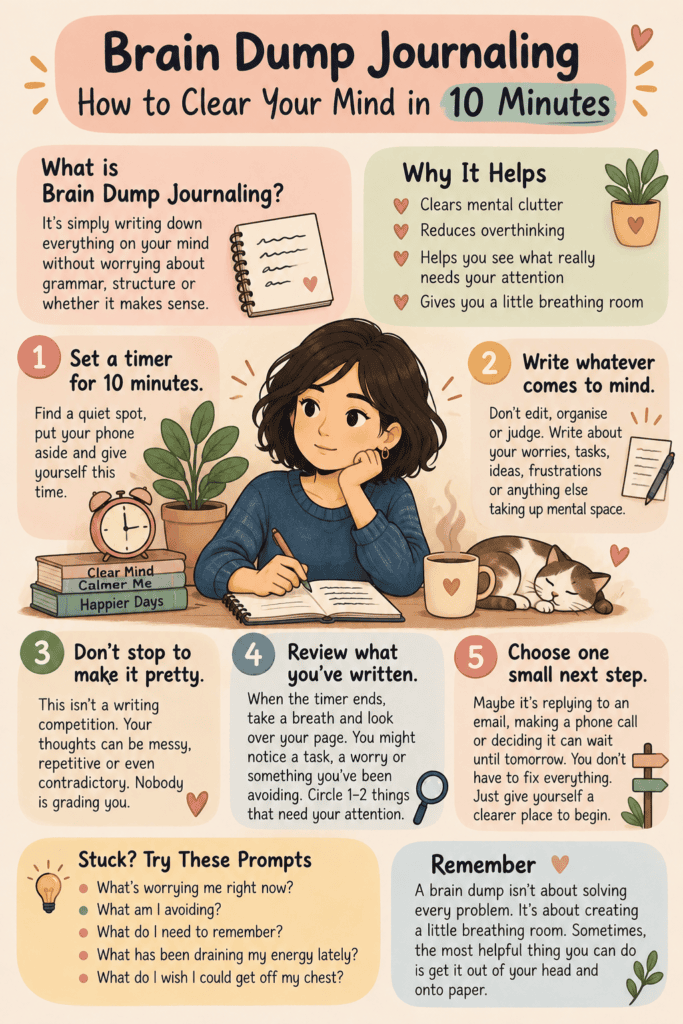
Brain dump journaling is the practice of writing down everything that’s occupying your mind without worrying about grammar, structure, or whether your thoughts make sense. Instead of trying to organise everything in your head, you put it on paper first.
The idea is simple: get your thoughts out, create some mental breathing room, and figure out what needs your attention.
How Does Brain Dump Journaling Help?

When too many thoughts compete for your attention, it can be difficult to decide what needs your attention first. Writing them down gives you a chance to step back, see what’s bothering you, and identify what you can do about it.
A brain dump isn’t about solving every problem. It’s about creating a little breathing room.
You might discover an unfinished task you’ve been avoiding, a worry that keeps returning, or simply how much you’ve been trying to keep track of. Once everything is on paper, it may feel easier to look at one thing at a time.
How to Do a Brain Dump in 10 Minutes?
You don’t need a fancy journal, beautiful handwriting, or the perfect cup of coffee. A notebook and ten minutes are enough.
Step 1: Set a timer for 10 minutes.
Find a quiet spot, put your phone aside, and give yourself permission to write without interruptions.
Step 2: Write whatever comes to mind.
Don’t edit, organise, or judge your thoughts. Write about your worries, unfinished tasks, random ideas, frustrations, or anything else taking up mental space.
Stuck? Start with these prompts:
- What’s worrying me right now?
- What am I avoiding?
- What do I need to remember?
- What has been draining my energy lately?
- What do I wish I could get off my chest?
Step 3: Don’t stop to make it pretty.
This isn’t a writing competition. Your thoughts can be messy, repetitive, incomplete, or even contradictory. Nobody is grading you.
Step 4: Review what you’ve written.
When the timer ends, take a breath and look over your page. You might notice a task you need to complete, a worry you can’t control, or something you’ve been putting off.
Circle one or two things that genuinely need your attention. Leave the rest for another time.
Step 5: Choose one small next step.
Maybe it’s replying to an email, making a phone call, or deciding that something can wait until tomorrow.
You don’t have to fix your entire life in ten minutes. Just give yourself a clearer place to begin.
Want to Make Brain Dump Journaling Easier?

If you’ve ever stared at a blank page wondering where to begin, I’ve got you covered!
I’ve created free Brain Dump Worksheets to help you get your thoughts out of your head and onto paper without feeling overwhelmed. They’re simple to use, even on days when your mind feels all over the place.
Download your free Brain Dump Worksheet.
Set aside ten minutes, grab a pen, and let your thoughts flow. No overthinking, no pressure—just a little space for yourself.
What If You Don’t Know What to Write?
Start with this sentence:
“Right now, my mind is full of…”
Then keep writing.
If your thoughts jump from work to relationships to grocery lists, let them. That’s the whole point. A brain dump is meant to capture what’s on your mind, not turn it into a perfectly organised essay.
You can also try brain dumping before bed, at the start of your workday, or whenever your thoughts feel overwhelming. Find a time that works for you rather than forcing yourself into another rigid routine.
Brain Dump Journaling vs. Regular Journaling
Regular journaling often involves reflecting on experiences, exploring emotions, or answering specific prompts. Brain dump journaling is less structured. You simply empty your thoughts onto the page before deciding what, if anything, to do with them.
Both approaches can be useful. You don’t have to choose just one.
A Small Reminder Before You Go
Your mind wasn’t designed to be a storage cupboard for every task, worry, idea, and unfinished conversation.
Sometimes, the most helpful thing you can do is stop trying to remember everything and start writing it down.
So, grab a notebook today and give yourself ten minutes. No rules, no pressure, and absolutely no need to make it Instagram-worthy.
You don’t need to have everything figured out. Sometimes, you just need to get it out of your head.
If journaling, self-reflection, or building healthier habits resonates with you, you might enjoy my book, Tiny Habits Massive Results.
In this book, I share small, practical habits that have helped me work on my mental and emotional well-being, find a little more peace, and sail through life’s challenges with a healthier mindset. It’s about making meaningful changes without trying to transform your entire life overnight.
Because sometimes, it’s the smallest habits that help us move forward in life.