Have you ever agreed to something you didn’t want to do, simply because saying no felt uncomfortable?
If yes, you may be experiencing the hidden cost of being too nice. Being “too nice” means consistently putting other people’s needs ahead of your own out of fear, guilt, or a desire for approval—even when it comes at the expense of your own well-being. Over time, this pattern, often called people pleasing, can lead to emotional exhaustion, resentment, and difficulty setting healthy boundaries.
The good news? You don’t have to stop being kind. You simply need to learn the difference between kindness and self-abandonment.
If you’ve ever smiled when you were hurt…
Said “It’s okay” when it really wasn’t…
Or found yourself saying “yes” while every part of you wanted to say “no”…
This article is for you.
Kindness vs. People Pleasing
Being kind is a beautiful quality.
Being too nice isn’t.
That may sound surprising, but the difference lies in why you’re helping.
Kindness comes from choice.
People pleasing comes from fear.
When you’re kind, you help because you genuinely want to.
When you’re people pleasing, you help because you’re afraid of disappointing someone, being judged, creating conflict, or not being liked.
On the surface, both look similar.
Inside, they feel completely different.
For years, I confused the two.
I believed saying yes made me a better person. I thought avoiding conflict meant I was being mature. I worried that disappointing someone would damage the relationship.
So I kept saying yes.
Yes to requests I didn’t have time for.
Yes to conversations I didn’t have the energy for.
Yes to commitments I secretly hoped would get cancelled.
I told myself I was being generous.
In reality, I was slowly abandoning myself.
The Hidden Cost of Being Too Nice
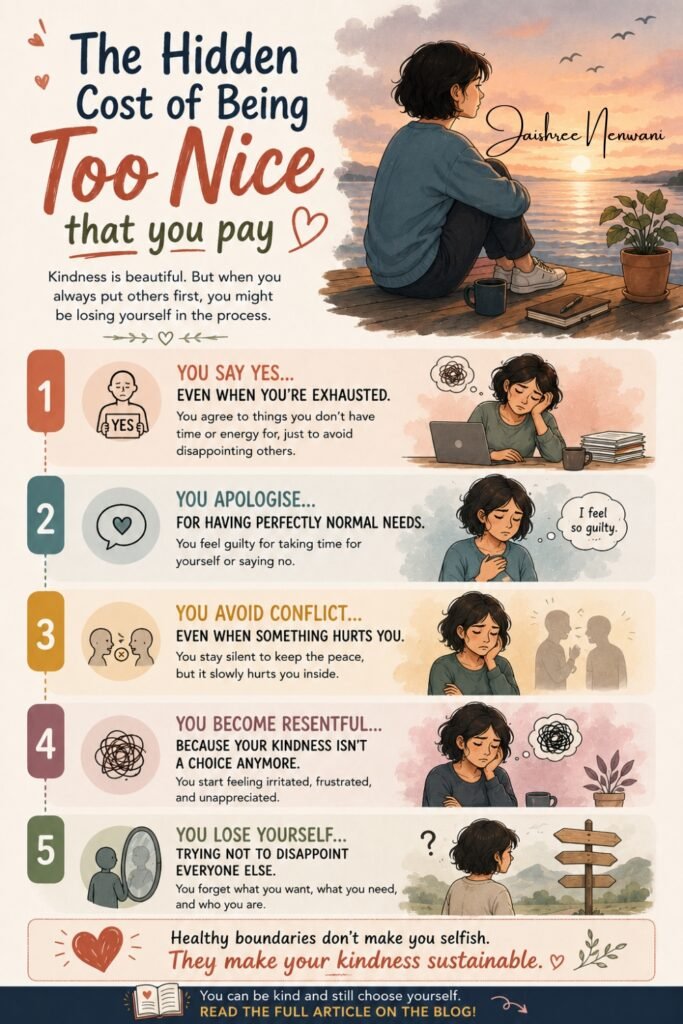
The cost of people pleasing rarely appears overnight.
It builds quietly.
You start feeling emotionally drained without knowing exactly why.
You become frustrated with people who, ironically, never forced you to say yes in the first place.
You lose sight of your own priorities because you’re constantly managing everyone else’s.
Eventually, even simple decisions become difficult because you’re used to seeking approval before trusting yourself.
Perhaps the hardest part is this:
Most people don’t notice the sacrifices you’re making.
They simply become accustomed to them.
What began as kindness slowly becomes an expectation.
Why Do People Become People Pleasers?
Nobody is born believing they must earn love by keeping everyone happy.
People pleasing often develops through life experiences.
Maybe you were praised for always being “the good one.”
Maybe saying no made you feel guilty.
Maybe keeping the peace felt safer than speaking your mind.
Or maybe you learned that your value came from being helpful.
Over time, these experiences become beliefs.
“If I say no, they’ll think I’m selfish.”
“Good people always put others first.”
“My needs can wait.”
The problem isn’t kindness.
The problem is believing your needs matter less than everyone else’s.
5 Signs You’re Being Too Nice
If you’re wondering whether this applies to you, here are a few common signs:
- You feel guilty whenever you say no.
- You often feel emotionally exhausted after helping others.
- You avoid conflict, even when something genuinely bothers you.
- You apologise for having normal needs or boundaries.
- You agree to things you later resent.
If you recognised yourself in several of these, you’re not broken.
You’re simply following a pattern that can be changed.
The Backpack You Never Realised You Were Carrying
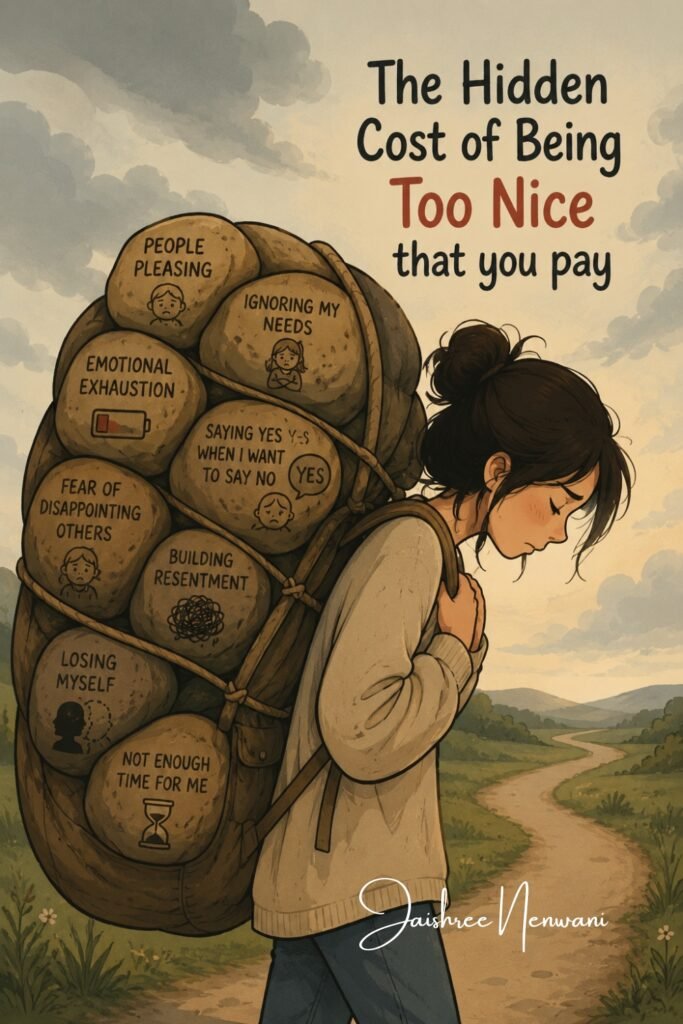
Imagine carrying a backpack.
Every time you ignore your own needs to keep someone else comfortable, another stone goes inside.
One favour.
One obligation.
One uncomfortable yes.
One forced smile.
Individually, they don’t seem heavy.
But over time, the weight becomes impossible to ignore.
That’s why many people feel exhausted even when they haven’t done anything physically demanding.
They’re not tired because they’re doing too much.
They’re tired because they’re carrying too much.
Healthy Boundaries Don’t Push People Away
For a long time, I misunderstood healthy boundaries.
I thought boundaries were walls.
Something that pushed people away.
Now I think of them differently.
Boundaries are doors.
You decide who comes in.
You decide when they’re open.
And you decide when they need to close so you can rest.
The people who genuinely care about you may need time to adjust.
But they’ll learn to respect your honesty.
The people who only benefited from your inability to say no?
They may not like your boundaries.
That doesn’t mean your boundaries are wrong.
A Simple Question That Can Change Everything
The next time someone asks you for something, don’t answer immediately.
Pause.
Ask yourself:
“Am I saying yes because I truly want to—or because I’m afraid of saying no?”
That one question has the power to interrupt years of automatic people pleasing.
Sometimes you’ll still say yes.
And that’s perfectly okay.
The difference is that your yes becomes intentional instead of automatic.
Real Kindness Includes You
You can care deeply without carrying everyone’s problems.
You can be generous without constantly running on empty.
You can support others without sacrificing your own peace.
And yes—you can say no without being a bad person.
Because every unnecessary yes is often a no to your own time, energy, and emotional well-being.
The healthiest version of kindness doesn’t ask you to disappear.
It makes room for you too.
Real kindness includes kindness toward yourself. When you stop people pleasing and start setting healthy boundaries, your relationships become more honest, your energy lasts longer, and your kindness becomes a choice instead of an obligation.
A Free Guide for You: How to Say No Without Feeling Guilty
If setting boundaries feels uncomfortable, you’re not alone.
The good news is that saying no is a skill—not a personality trait.
That’s exactly why I created a free guide called How to Say No Without Feeling Guilty.
Inside, you’ll discover:
- Simple scripts you can use in everyday situations
- Practical mindset shifts to overcome guilt
- Easy exercises to build confidence while setting healthy boundaries
If you’ve spent years being “too nice,” this guide will help you protect your time and energy—without becoming rude or uncaring.
Download your free copy and take the first step towards healthier boundaries.